
What Greene County Property Tax Records Show
A Greene County tax record packs many fields onto one page. Here is what each one means for an owner of record.
| Field | What It Shows | Where |
|---|---|---|
| Assessed value | Value used for taxes | ASSESSOR |
| Market / appraised value | Estimated full value | ASSESSOR |
| Exemptions | Homestead, senior, veteran | ASSESSOR |
| Tax bill & status | Amount due, paid/delinquent | TREASURER |
| Taxing districts | School, city, special | TREASURER |
assessed vs market value, and why the tax bill is not the sale value.
Greene County Assessment Fields
PROS keeps land assessed value, total assessed value, and taxable values in separate fields. The equalization rate gets its own field too. Calculated full market value, exemptions, and sale history each get their own place. Building inventory does as well. One inspected parcel card showed a $305,500 total assessment beside a 26 percent equalization rate. It also showed a calculated $1,175,000 full market value and a $1,020,000 sale. That example shows the structure. It is not a countywide rule. The assessed figure drives tax administration. The full-value figure is simply calculated, and the sale amount reports a transaction only when one exists. The inspected PROS assessment panel displays these fields side by side.
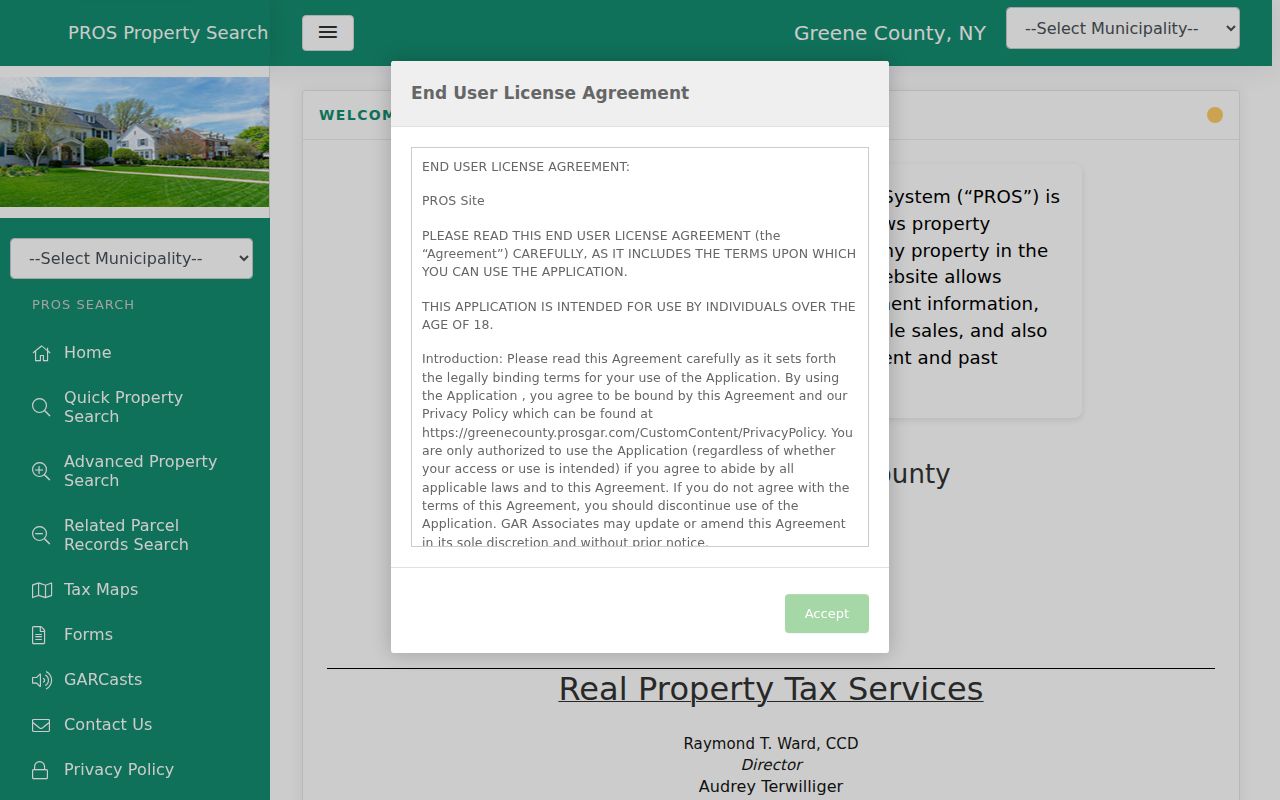
The panel makes one thing obvious. Land value, total value, taxable value, and full market value are distinct numbers that should never collapse into a single figure.
Greene County Tax Status
For payment status, the County Treasurer points to Total Collection Solution. Pick Entities. Type the SBL with its dots and dashes, confirm the SWIS and owner, and open the parcel detail. Tax years, charges, payments, dates, and payer details appear, each with its own flag. DEFAULTED can signal a failed payment plan. BUNDLED can join several years in one arrangement. LINES can point to a school re-levy. The county cautions that payer data from before August 2011 may be inaccurate. Keep in mind that a payment record shows who paid, not who held title. The county tax portal offers the parcel and year lookup.
Always check the SBL and SWIS first. A balance attributed to the wrong parcel is the easiest mistake to make in Greene County tax research.
Town and County Tax Custody
Tax custody shifts during the year. Towns generally collect current town taxes locally through July 31. After that, unpaid amounts pass to the County Treasurer as delinquent. Village and school calendars run on their own schedules. So a blank county result may simply mean the charge still sits with a town collector. It does not mean no tax is due. Read the county tax-calendar page and call the right collector for the year in question.
Challenging an assessment follows a different path. New York publishes tentative and final rolls. It holds an annual grievance period. It processes RP-524 complaints through a Board of Assessment Review before any court review. The parcel's town roll and current calendar control the filing date. Helpful evidence can include a recent appraisal. Comparable sales, photographs, or proof of an inventory error also count. The assessment office can fix some bill mistakes, but a grievance must meet its deadline.
Looking Up a Greene County Tax Bill
Finding a Greene County tax bill takes a parcel number or an address. Here is the route from either starting point to the payment status on record.
- search the Total Collection Solution by address or parcel
- read the current bill, prior years, and payment status
- check exemptions applied on the assessor record
- note delinquency and any tax lien or pending sale
- Assessed value
- Definition - the taxable portion.
- Mill rate / levy
- Definition - how the tax is computed.
- Homestead exemption
- Definition - owner-occupied relief.
- Tax lien
- Definition - claim for unpaid taxes.
Appealing a Greene County Assessment
A Greene County owner can contest an assessed value each year. The process runs through the review board, a firm deadline, and evidence that speaks for the parcel.
Appeal window. 1-2 sentences - Greene County assessment appeals must be filed by the deadline on the applicable town grievance calendar with the local Board of Assessment Review.
Greene County Access Channels
Digital access covers only part of the picture for Greene County property records. The County Clerk keeps a public counter at 411 Main Street in Catskill. Behind that counter sit the recorded land documents, searchable online through SearchIQS. Real Property Tax Services ties together more sources. Its offerings include PROS, annual town assessment rolls, GIS, deeds, state sales data, and tax-rate material. Offerings also cover state sales data and tax-rate material. The County Treasurer runs a separate tax search and posts a tax calendar. When a web search comes up empty, go to the office that created the record. The County Records Center is not that office. It stores inactive files from more than thirty departments. It does not serve the public. The originating department stays the contact point.
New York's Freedom of Information Law governs existing state and local agency records. Describe the item reasonably and send the request to the agency records access officer. The agency must generally grant, deny, or acknowledge within five business days. FOIL cannot force staff to build a new record. It cannot make them answer a research question either. Ask instead for things that already exist. A dated assessment roll, parcel file, permit application, map, or correspondence all qualify. Courts sit outside FOIL. Their files follow Judiciary Law section 255 and the clerk's access process.
Municipal files demand careful routing. Greene County holds fourteen towns and five villages, with no incorporated city. Building permits, zoning decisions, code files, and subdivision approvals usually belong to the town or village involved. Permits and zoning files belong to the town or village involved. So do subdivision approvals. County Planning handles referrals and support where the law requires it. Still, it never replaces the local board's subdivision jurisdiction. A Catskill mailing address can mean the town or the village. Note the exact municipality, SWIS, SBL, ZIP, and source year before requesting anything.
Historic work has its own fallback chain. The Clerk's index books and deed books anchor most deep searches. FamilySearch catalogs older Greene County deed, grant, and index runs. The Catskill Public Library offers digitized local newspapers plus reference help. At the Vedder Research Library, family papers, maps, photographs, and special collections wait in the stacks. Family papers and maps wait in the stacks there. Special collections do too. Its online finding aids show only a small share of what it holds. The New York State Library and State Archives add newspaper holdings and government-record finding aids. A newspaper clipping or family paper is context, never title proof. Historic-register entries fall in the same category. Tie every finding back to a recorded deed and the same parcel description.
Keep a source ledger for every result. Record the office, URL, access date, and exact search term. Also record the municipality, SBL, roll year, deed book and page, and copy status. That habit exposes stale assessment data, name variants, changed addresses, and shifting custody periods. Greene County's online records keep moving. Deeds post, rolls finalize, maps get revised, and taxes pass between collectors. Confirm any fact affecting a purchase, boundary, estate, tax filing, or legal right with the office that holds the record. Confirm it before you rely on it. The office that holds the record has the final word.
Greene County Record Checks
A thorough check anchors one parcel identity across every system. Begin with the physical address and municipality. Save the SBL and SWIS. Note the owner name exactly as displayed. Then compare that parcel against the map, the tax collection history, and the deed reference. Disagreements between sources usually trace back to dates. A deed can record before PROS catches up. A tax charge can sit with a town before transferring to the county. A map may reflect a revision made after an older plat. Never erase the conflict. Save both results, then ask the responsible office which date controls.
The annual Real Property Tax Services reports show the maintenance effort behind these systems. In 2024 the county reported 2,476 transfers and 155 recorded plats. It also logged 247 tax-map revisions, continued WebMap updates, and ongoing assessment and parcel-history work. All plats had been scanned. But the report separated scanning from remote availability. It described IQS work adding map images from 2010 forward. An older plat may exist digitally at an office. Yet no public web image may open for it. Request it by map title, filing date, instrument reference, or parcel description.
Greene County's land history shapes modern searches too. The county formed in 1800, and Catskill became the county seat. Later town and village changes left old place names that fit today's postal labels poorly. River parcels may carry landing, creek, wharf, mill, or turnpike terms. Mountain and farm tracts lean on metes and bounds. They also lean on neighboring owners, resort names, roads, or agricultural descriptions. Search the current address and the record's own era language together.
The public portals have firm limits. PROS is assessment-oriented and disclaims any guarantee of currency or completeness. SearchIQS indexes recorded documents, keyed mainly by party name. GreeneWebMap is a spatial and tax-map aid, not a survey. The Treasurer portal tracks tax custody, and its flags can require interpretation. A permit application proves only that review was sought. It does not prove the work was finished or approved. A newspaper or archive reference gives context, never ownership proof. Matching several sources strengthens a conclusion. Even so, no match replaces a title examination, certified record, professional appraisal, or licensed survey. Use one when it is required.