
What the Greene County Current Owner Record Shows
The fields that name the current owner of record for a Greene County property, with a plain explanation of what each one actually means.
| Owner of Record | Name(s) vested today |
|---|---|
| Vesting / Tenancy | Joint tenants, trust, LLC, etc. |
| Mailing Address | Where the owner gets tax notices |
| Situs Address | The property itself |
| Deed Reference | The recording that vested them |
| Ownership Since | Date of the current deed |
The owner of record is not always the occupant.
Greene County Owner Card
The PROS Owner Information block lists an Owner Name plus Address 1 and Address 2, PO Box, City, State, ZIP, Unit Name, and Unit Number. Read it beside Property Description and Location. One group identifies the roll owner and the mailing destination, while the other identifies the land itself. Confusing them misplaces owners. Match on the parcel SBL and municipality instead. The official sample owner card displays the local field arrangement used in Greene County.
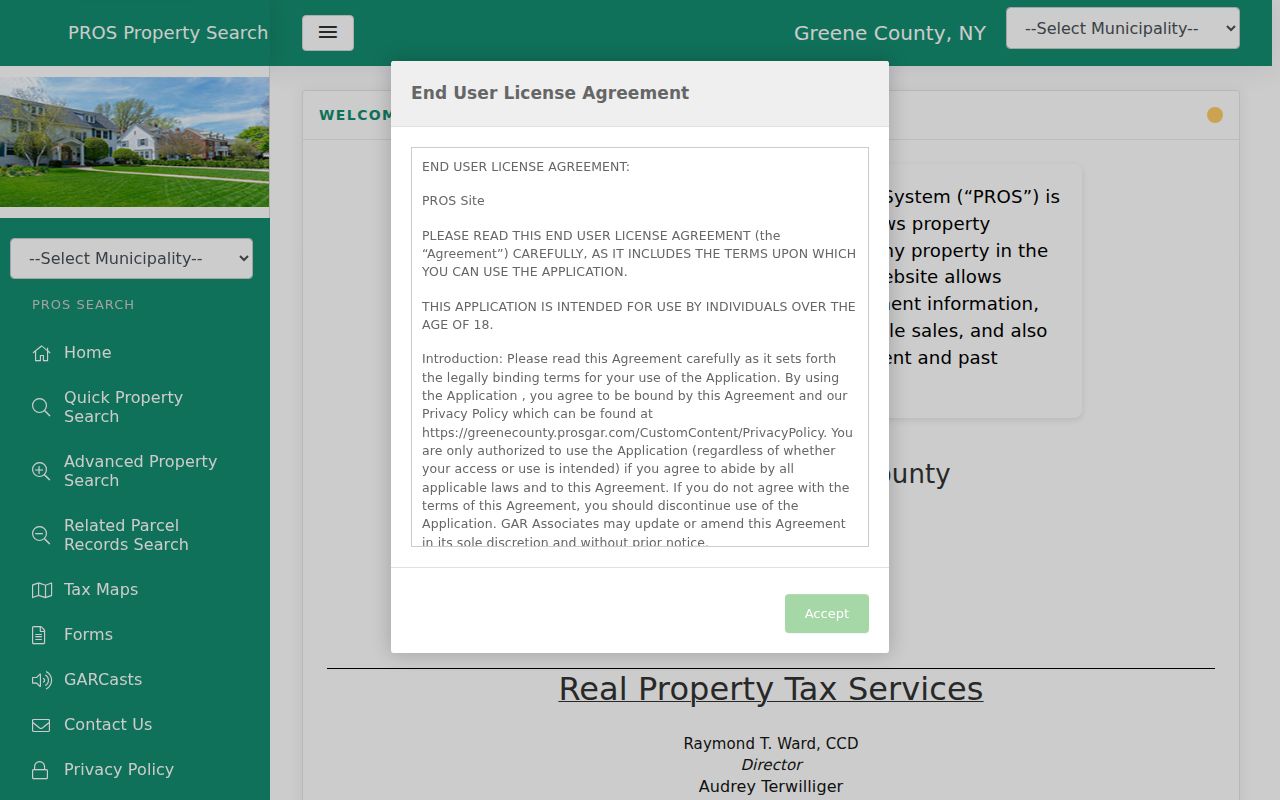
The image shows why the owner card records the mailing address and the situs address under their own separate labels.
When the Greene Roll Lags
PROS terms warn that information may be delayed, incomplete, or inaccurate. Greene County publishes no average transfer-update lag. After a recent sale, compare the parcel's last-sale date and deed reference with SearchIQS. The latest recorded deed names a new grantee first. The annual or working roll catches up on its own schedule.
Owners may be estates, trustees, LLCs, or co-grantees. Preserve the exact vesting words from the deed. Some filings convey only part of the interest. For a company, the state business database supplies filing facts and a service address only, never a substitute for recorded title.
Protecting Greene County Ownership
The County Clerk's free Fraud Alert sends notice whenever a deed or mortgage records under a watched name. Owners can register name variants and entity names. Then inspect any instrument that triggers an alert through SearchIQS or at the Clerk's office. The service only gives notice. It blocks no recordings and guarantees no title.
For contact, use the mailing address printed in the public assessment record and keep the purpose tied to the property. New York's Address Confidentiality Program may replace an eligible person's address in government interactions, even though older public documents still hold historic addresses. Never use owner data for harassment.
Confirming the Current Owner in Greene County
Confirm the owner with the latest recorded deed.
- read the owner of record on the Greene County PROS
- pull the most recent deed in the SearchIQS to confirm vesting
- if an LLC or trust, identify the people behind it via the Secretary of State
- note the owner mailing address for contact
- Owner of record
- The party the records show as owner.
- Vesting
- How title is held - joint, trust, entity.
- Registered agent
- The contact for an LLC/entity owner.
Reaching a Greene County Property Owner
A Greene County tax roll mailing address is the lawful way to reach the owner of record. Much else stays private, and the limits are firm.
Lawful use. 1-2 sentences - contacting a Greene County owner through the public mailing address is fine for property matters; using owner information to harass or intimidate is a crime under New York law.
Greene County Access Channels
Digital access is only one way in. Greene County still runs on offices. The County Clerk keeps a public counter at 411 Main Street in Catskill and holds the recorded land documents behind SearchIQS. Real Property Tax Services ties together PROS, the annual town assessment rolls, GIS, deeds, state sales data, and tax-rate material. The Treasurer runs its own tax search and calendar. A dead-end web search should lead you to the office that created the record, never to the County Records Center. That center stores inactive files from more than thirty departments and does not serve the public. Go to the originating department instead.
New York's Freedom of Information Law covers existing state and local agency records. Describe the item reasonably and send the request to the agency's records access officer. The agency generally must grant, deny, or acknowledge within five business days. FOIL never forces staff to build a new record or answer a research question. So ask for something concrete: a dated assessment roll, a parcel file, a permit application, a map, or correspondence. Courts sit outside FOIL. Their files follow Judiciary Law section 255 and the clerk's access process.
Municipal files need careful routing too. Greene County holds fourteen towns and five villages with no incorporated city. Building permits, zoning decisions, code files, and subdivision approvals usually belong to the town or village involved. County Planning handles referrals and support where the law requires it, but it cannot replace the local board's subdivision jurisdiction. A Catskill mailing address can mean the town or the village. Note the exact municipality, SWIS, SBL, ZIP, and source year before requesting anything.
Old records have their own fallback chain. The Clerk's index books and deed books remain central to any deed records search. FamilySearch catalogs older Greene County deed, grant, and index runs, and the Catskill Public Library offers digitized newspapers plus reference help. The Vedder Research Library keeps family papers, maps, photographs, and special collections, though its online finding aids show only a small share. The State Library and State Archives add newspaper holdings and government-record finding aids. A newspaper clipping or family paper is context, not title proof. Anchor every finding to a recorded deed and its parcel description.
Keep a source ledger for each result: office, URL, access date, search term, municipality, SBL, roll year, deed book and page, and copy status. This habit catches stale assessment data, name variants, changed addresses, and shifting custody. Online property records change constantly as deeds post, rolls finalize, maps are revised, and taxes move between collectors. Before acting on any fact tied to a purchase, boundary, estate, tax filing, or legal right, confirm it with the office that holds the record.
Greene County Record Checks
A solid check pins the same parcel identity across systems. Start with the address and municipality. Save the SBL and SWIS. Copy the owner of record name exactly as displayed. Then compare the parcel against the map, the tax collection history, and the deed reference. When sources disagree, dates usually explain why. A deed can record before PROS updates. A tax charge can linger with a town before the county takes over. A map may reflect a revision newer than an older plat. Do not erase the conflict. Save both results and ask the responsible office which date controls.
The annual Real Property Tax Services reports show the machinery at work. For 2024 the county logged 2,476 transfers. It recorded 155 plats and 247 tax-map revisions, along with continued WebMap updates and parcel-history work. Every plat had been scanned. The report separated scanning from remote availability. It also described IQS work adding map images from 2010 forward. An older plat may still exist digitally at an office. No image may open on the public side. Request it by map title, filing date, instrument reference, or parcel description.
Land history shapes modern property searches in Greene County. The county formed in 1800 with Catskill as the seat. Later town and village changes left place names that fit no current postal label. River parcels speak of landings, creeks, wharves, mills, and turnpikes. Mountain and farm tracts lean on metes and bounds, neighboring owners, resort names, roads, or agricultural descriptions. Search the modern address and the era's own language alike.
Know the limits of each portal. PROS is assessment-oriented and disclaims any guarantee of currency or completeness. SearchIQS indexes recorded documents mainly by party name. GreeneWebMap is a spatial and tax-map aid, not a survey. The Treasurer portal follows tax custody and can carry flags needing interpretation. A permit application proves review was sought, not that work was finished or approved. Newspapers and archives give context, not ownership. Matching several sources builds a stronger property records conclusion. Yet it cannot replace a title examination, certified record, professional appraisal, or licensed survey when one is required.