
Greene County Deed Records and What They Show
A recorded Greene County deed proves which interest changed hands, and the recorder indexes the common deed types that appear in the books.
| Deed Type | What It Does | Common Use |
|---|---|---|
| Warranty deed | Full ownership with guarantees | Standard sales |
| Quitclaim deed | Transfers whatever interest exists | Family, divorce, cleanup |
| Grant / special warranty | Limited guarantees | Some sales, New York custom |
| Trustee / executor deed | Transfer from an estate or trust | Probate, foreclosure |
| Tax deed | Transfer after a tax sale | Delinquent-tax properties |
The distinction matters: a deed conveys ownership, while a mortgage or lien merely encumbers it, yet the recorder files all of them together.
Greene County Name Index
SearchIQS is the Greene County Clerk's entry point for recorded documents. The Clerk is clear on one limit. Searches run by name, not by street address or SBL. So start in PROS, the assessment system, and find the current roll owner. Then search that party as a grantee. Only after useful matches appear should you narrow by document type or date. Write down every grantor, grantee, execution and recording date, book and page, instrument number, municipality, consideration clue, legal description, and prior reference shown. Each instrument type tells a different story. A deed transfers an interest, and a mortgage secures a debt. A satisfaction releases a recorded mortgage. A notice of pendency flags litigation affecting the land.
Name variants matter more than you might expect. Try initials, married names, estate and trustee forms, and corporate punctuation. A deed caption will steer the next query far better than a casual spelling on a tax bill. The Greene County SearchIQS portal shows the guest land-record entry.
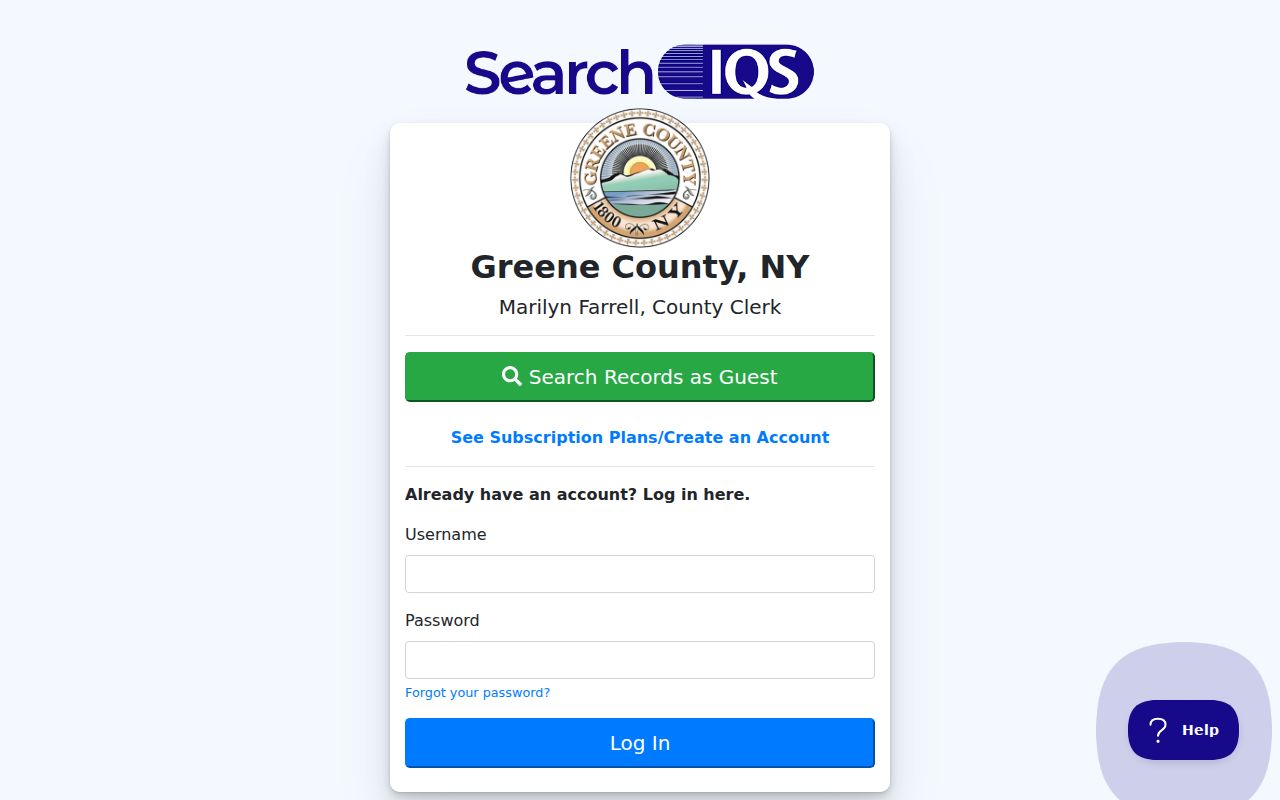
The image helps distinguish free guest searching from subscription and document-print options.
Deed Books Since County Formation
The County Clerk's holdings reach back to the county's earliest years. Grantor indices run from 1800 through 1991. Corporate grantor and grantee indices cover 1890 through 1991. Lis pendens indices span 1924 through 2004. The Clerk's historic material also identifies deed books through Book A-765. The FamilySearch catalog describes deed books for 1825 through 1910, grant books for 1854 through 1929, and indexes for 1825 through 1968. These ranges describe different collections. Do not assume every image is online or that every instrument survives in the same form.
Greene County was formed in 1800. Later town and village changes can make early descriptions look unfamiliar. When a modern street does not appear, follow the legal description instead. Adjoining owners, waterways, farms, turnpikes, and plats can anchor the parcel across centuries. For records outside the current image set, the Clerk counter remains one fallback. The Indexbooks remain another.
Greene County Fraud Alerts
The Clerk promotes a free recording alert for deeds and mortgages. A user supplies a location, an email, and up to ten names. The alert reports that a document was recorded under a watched name. It cannot stop a filing or judge validity. If something looks unfamiliar, open the cited instrument online or inspect it with the Clerk. Then contact the proper office. The New York Attorney General also publishes deed-theft guidance. The official Greene County Fraud Alert form displays its signup fields.
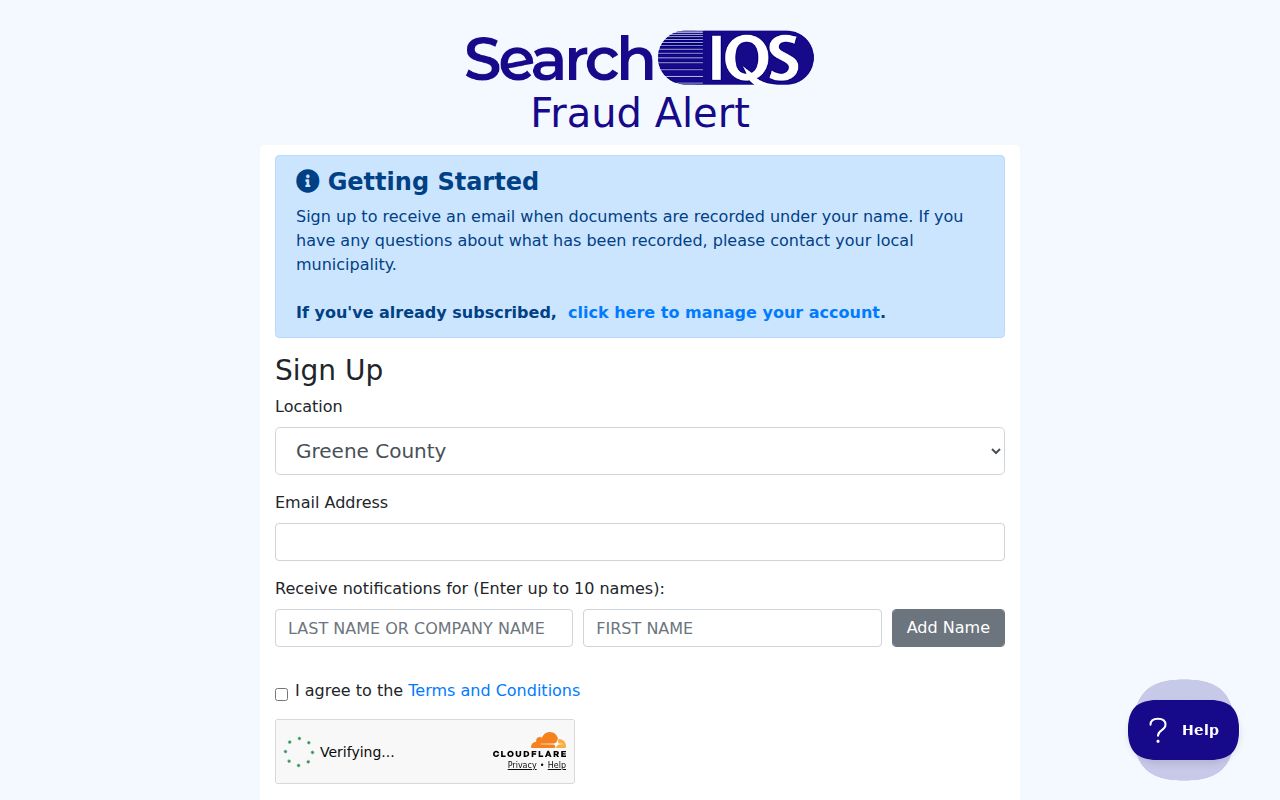
The capture shows why exact personal and entity name variants should be registered separately.
The Greene County Grantor-Grantee Index
In Greene County, the recorder's index is arranged by grantor and grantee, and tracing ownership means walking that chain backward through each recorded instrument.
- find the current owner's purchase deed (owner as grantee)
- read the prior owner (the grantor) from that deed
- search that prior owner as grantee to step back again
- note the online cutoff; go to deed books for earlier years
- Grantor
- The party transferring - the seller.
- Grantee
- The party receiving - the buyer.
- Chain of title
- The ordered sequence of deeds for a property.
- Book/Page vs Instrument #
- How Greene County references a recorded document.
Getting a Copy of a Greene County Deed
Getting a copy of a recorded Greene County deed takes one of four routes: the online image, the counter, a mail request, or the fee schedule for plain versus certified copies. Each option leads to the same recorded instrument.
Recorded, not guaranteed. 1-2 sentences - the Greene County deed index shows what was recorded; it is not a title opinion, and unrecorded interests can exist. A title search confirms clear ownership.
Greene County Access Channels
The county clerk's counter sits at 411 Main Street in Catskill. That office keeps the recorded land documents and offers SearchIQS for online deed lookups. Real Property Tax Services gathers more tools under one roof. Its pages connect PROS and annual town assessment rolls. GIS, deeds, state sales data, and tax-rate material appear there too. The County Treasurer runs its own tax search and calendar. A dead-end web search should lead you to the office that created the record. The County Records Center stores inactive files from more than thirty departments. It does not serve the public directly. The originating department remains the contact.
New York's Freedom of Information Law covers existing state and local agency records. Describe the item reasonably and send the request to the agency's records access officer. An agency generally must grant, deny, or acknowledge within five business days. FOIL cannot force staff to create a new record or answer a research question. So ask for something concrete. A dated assessment roll, parcel file, permit application, map, or correspondence all work. Courts sit outside FOIL. Court files follow Judiciary Law section 255 and the clerk's access process.
Municipal routing takes care. Greene County holds fourteen towns and five villages and no incorporated city. Building permits, zoning decisions, and code files usually belong to the town or village involved. Subdivision approvals sit there too. County Planning handles referrals and support when required. It cannot replace the local board's subdivision jurisdiction. A Catskill mailing address might mean the town or the village. Write down the exact municipality, SWIS, SBL, ZIP, and source year before requesting anything.
Historic work follows its own chain. The Clerk's index books and deed books stay central throughout. FamilySearch catalogs older Greene County deed, grant, and index runs. The Catskill Public Library offers digitized local newspapers plus reference help. At the Vedder Research Library you can dig into family papers, maps, photographs, and special collections. Its online finding aids cover only a fraction of what it holds. The New York State Library and State Archives add newspaper holdings and government-record finding aids. A newspaper item or family paper is context, never title proof. Anchor every find to a recorded deed with the same parcel description.
Keep a source ledger for each result. Log the office, URL, access date, search term, municipality, SBL, roll year, deed book and page, and copy status. That habit catches stale assessment data, name variants, changed addresses, and shifting custody. Greene County property records move constantly. Deeds post, rolls finalize, maps get revised, and taxes pass between collectors. Confirm any fact touching a purchase, boundary, estate, tax filing, or legal right with the office that holds the record.
Greene County Record Checks
A thorough check holds the parcel identity steady across systems. Begin with the physical address and municipality. Save the SBL and SWIS. Note the owner of record exactly as displayed. Then compare that parcel against the map, tax collection history, and deed reference. When two sources disagree, dates usually explain it. A deed can record before PROS catches up. A tax charge can linger with a town before transfer to the county. A map may reflect a revision made after an older plat. Do not erase the conflict. Keep both results and ask the responsible office which date controls.
The annual Real Property Tax Services reports show active maintenance. For 2024, Greene County reported 2,476 transfers, 155 recorded plats, and 247 tax-map revisions. It also reported continued WebMap updates and ongoing assessment and parcel-history work. Every plat had been scanned. The report still separated scanning from remote availability. It also noted IQS work adding map images from 2010 forward. An older plat may exist digitally at an office. This can be true even when no public web image opens. Request it by map title, filing date, instrument reference, or parcel description.
Deep land history shapes modern property search in Greene County too. The county formed in 1800. Catskill became the county seat. Later town and village changes left old place names that fit no current postal label. River parcels may speak of landings, creeks, wharfs, mills, or turnpikes. Mountain and farm tracts can lean on metes and bounds, neighboring owners, resort names, roads, or agricultural description. Search both the current address and the vocabulary of the record's own era.
Know each portal's limits. PROS is assessment-oriented and disclaims guaranteed currency or completeness. SearchIQS is a deed index keyed mainly by party name. GreeneWebMap is a spatial and tax-map aid, not a survey. The Treasurer portal tracks tax custody and can carry flags needing interpretation. A permit application proves only that review was sought. A newspaper or archive reference gives context, never ownership. Matching several sources strengthens any research conclusion. It still cannot replace a title examination, certified record, professional appraisal, or licensed survey. Use one of those where it is required.